Pratt Institute
Consumerism and the Weather app - Research study introduction
Overview
As the world’s population increases and consumption of natural resources increases, there is a need to develop structural solutions that can enable sustainable energy practices. While there are many mobile applications that offer personal accountability in sustainable daily habits, most require an investment of time and commitment from users in order to make a noticeable difference.
In places like New York City that have microclimates, people are constantly making snap decisions on their plans based on predicted weather conditions. For example, if a user notices that next week there will be days over 100° the user may purchase a portable fan to carry around. The Weather app allows users to find instant updates on climate forecasts, giving people the ability to predict and prepare for outdoor weather conditions. However, the app (on iOS) doesn’t just include temperature and rain; it covers everything from air quality to UV index to humidity and air pressure. This leads us to it as merely a source of information and nothing more, but what if the Weather app could be a force for enabling sustainable habits in a time where consumerism and spending is at an all time high?
In conducting a diary study of people’s use of the weather app, I sought to answer the following research questions:
- How does access to climate forecasts on the weather app alter people’s behavior including planned and actual patterns of consumption?
- How does looking up climate forecasts on the weather app raise user’s awareness of sustainability when it relates to their purchase behavior?
Through this research study, I hypothesized that observing the act of checking forecast information on the weather app would result in a positive correlation with both increased consumerism and awareness of the sustainability of their resulting purchasing habits.
My contribution
Researcher
The team
Solo project
Year
October 2025
Process
The research forecast is… - Diary study methods
The mixed methods study was conducted in three phases: pre-study interviews, diary study data collection, and post-study interviews. I recruited two participants, one located in New York City and one located in Los Angeles. These two cities offered a view on how weather conditions in different climates would affect people’s responses.
I conducted pre-study interviews in order to gain an understanding of how participants thought about their use of the weather app and if, at all, they viewed weather related-purchases with the lens of sustainable consumption. The questions focused on gaining an understanding of how people use the weather app and how people relate climate forecast information to their purchase habits. Both users mentioned using the app daily when planning outfits to wear and organizing events with friends. While both participants understood the concept of how sustainability and purchasing behavior was linked, one of them noted “I’m not sure if I’ve ever made a purchase directly because of the weather”, indicating a disconnect between their thoughts on their own sustainable behavior and the weather.
The diary study portion of the study was conducted over a period of two weeks. Participants were instructed to submit a diary entry with the following information every time a purchasing habit or product consumption decision was directly influenced by checking the forecast information on the weather app (known as an event).
- time of day they checked the weather app (morning, afternoon, evening)
- main aspect of the weather forecast that influenced their decision to change their purchase/shopping behavior (low temperature, high temperature, precipitation, other)
- description of the event, how the weather forecast influenced your purchase habits, what did they decide to buy or not buy
- Likert scale ranking of 1-5 on if they considered whether the purchase was an environmentally sustainable action (1=did not consider, 5=greatly considered)
At the end of the 2 week diary study period, I spoke to each participant to debrief and learn how taking part in the diary study had affected their perception of the link between the act of checking the weather app and their own purchasing behavior.
Checking the temperature - Diary study results
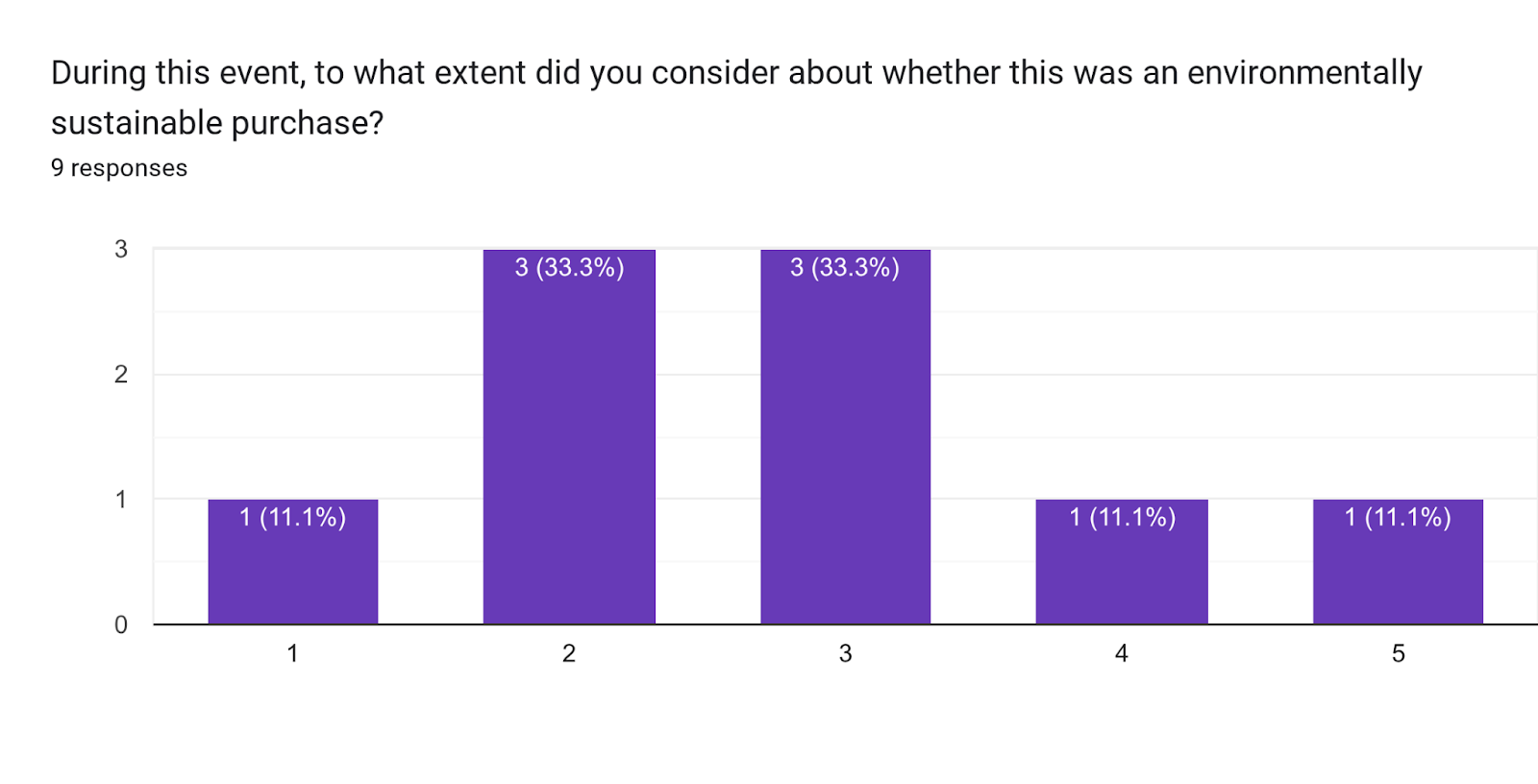
At the end of the study, I was able to collect a total of nine entries from participants through the diary study. Five entries reflected events occurring from checking the weather app in the morning, three in the afternoon, and one in the evening. Among these entries, five were related to low temperature, two about high temperature, one about precipitation, and one about high sunlight. When asked about how they considered if the event reflected sustainable purchase habits on a scale of 1-5 with 1 being not at all and 5 being greatly, each number was selected at least once, but 2 and 3 were chosen the most (three times) reflecting that users were more likely not considering sustainable purchase habits when making climate-based purchase decisions.
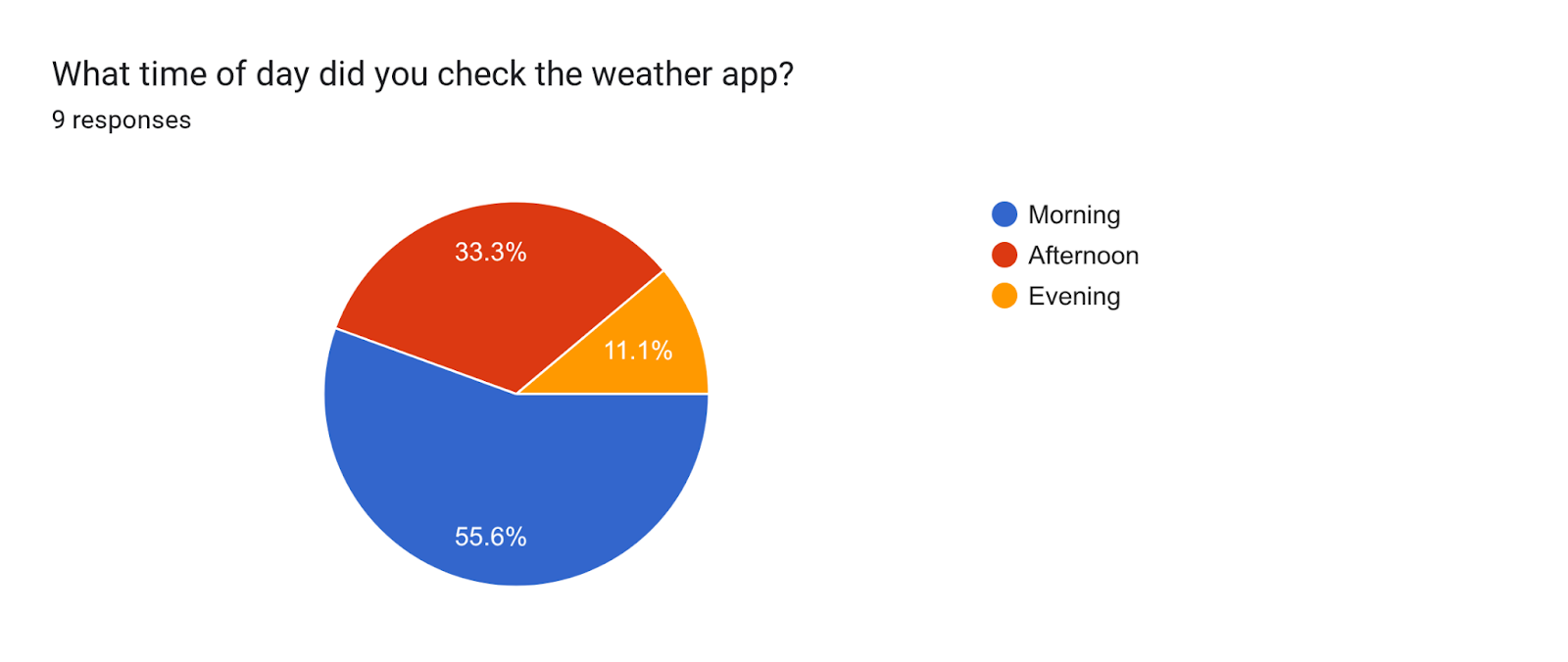
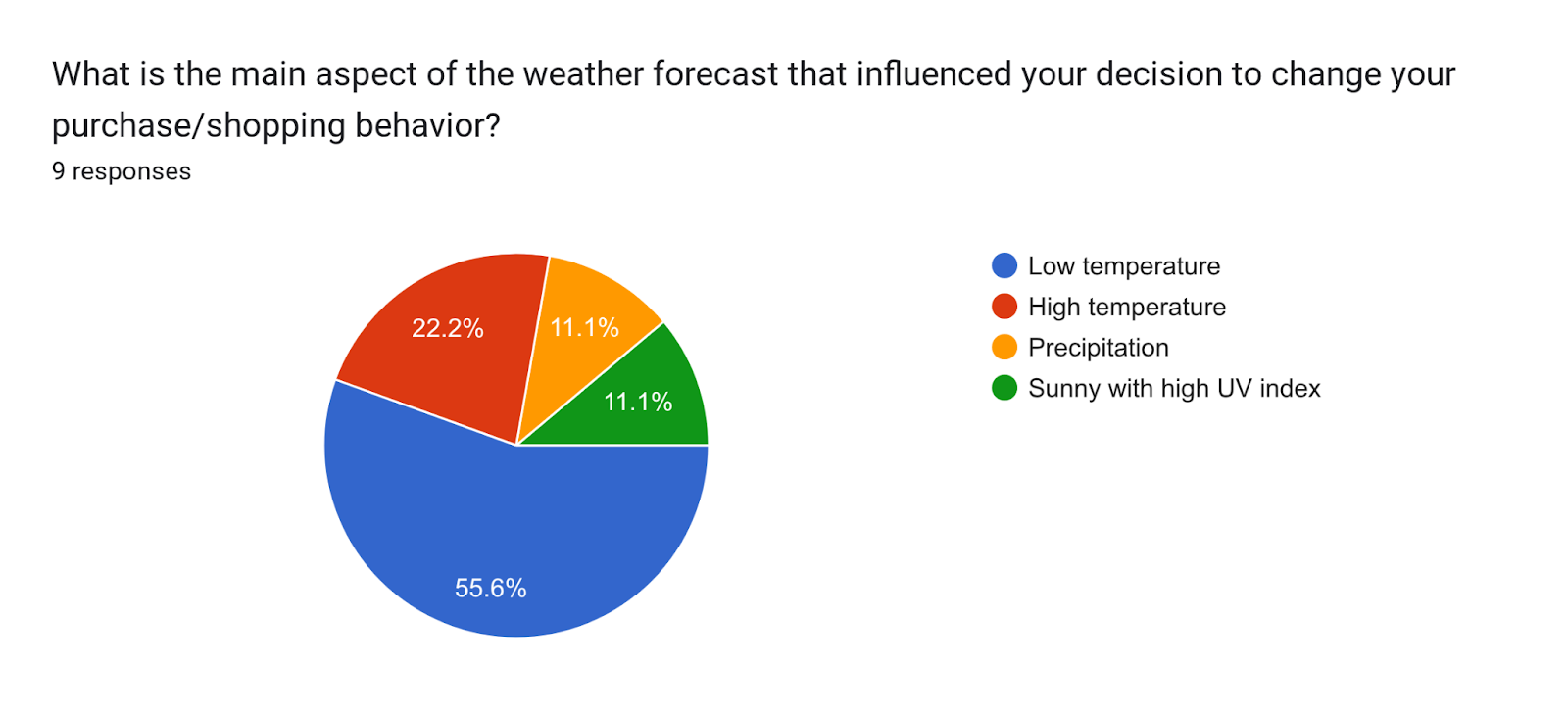
When analyzing participant’s descriptions of their events, four entries talked about increased purchases due to the weather app, three entries talked about reducing purchases, and two entries talked about substituting their intended purchase with another item. The most common entries simply stated how the forecast, present or future, inspired purchases that would be used when they were in those weather conditions, such as directly stating a causational relationship “I decided to buy mittens when it got too cold outside”.
A (non) change in the weather - evaluating the hypothesis
The main qualitative aspects of the study were the pre-study and post-study interviews and diary study event descriptions, as they gave insight into how real use cases of the weather app tied into people’s behavior and habits. The quantitative main aspect of the diary entries that supported this result was the Likert scale ranking, as a way to gauge whether sustainability was a part of their mindset in navigating these events. Evidence supporting the hypothesis would include a greater number of diary entries relating to increased forecast-related purchasing behavior compared to abstaining from forecast-related purchases.
After collecting 2 weeks worth of data and conducting post-study interviews with both participants, I was unable to conclude that utilizing the weather app significantly contributed to both awareness of and increased sustainable purchasing behavior. The average Likert score when participants were asked if they considered sustainable purchasing during the event was 2.78, below the suspected average value of 3.
The most detailed entries talked about reducing purchases, as participants would say what they were intending to buy, but then go into their thought process behind why they realized this purchase was unneeded.
- In response to low temperature forecast: “I intentionally went to two different stores to try to buy close toed shoes and/or a sweater to get warmer but ended up not buying either because the products were too expensive and not something I’d want to keep wearing.”
- In response to high temperature forecast: “I decided to see how the day went whether I actually needed to purchase shorts for the next few days of the trip. I didn’t want to make a snap addition to my wardrobe. It turned out that we were able to avoid the sun most of the day.”
What is interesting is that during the event, the overwhelming reason people cited on not making a purchase is that it was a personal choice based on overconsumption, and not directly inspired by the information provided by the weather app.
Taking a step outside - redesigning apps for sustainability
While the weather app could be designed in a way that incentivizes sustainable purchases, that would require significantly changing the directness of information that the app gives. Changing the app to be more personalized sacrifices the universality of weather forecasts; users check the weather app not because it has solutions, they check it because it is an easily interpreted way of learning about what they need to prepare for.
Instead of cluttering the weather app with additional inputs and outputs, there are opportunities to add weather information and trends to other apps. For example, a banking app could use a real time graph showing the correlation between a user's credit card spending and the temperature to make users be more aware of their spending on disposable items in certain types of weather. An energy company might highlight aspects of a homeowners bill by noting heavy usage of electricity during rainy days. Both of these ideas follow the weather app’s philosophy of providing information and raising possible issues without prescribing a solution. Providing interfaces that track each individual’s use of consumption is one way to achieve sustainability, but small instances of raising awareness on a larger scale may be just as effective.