Creating an equitable crosswalk experience for low-vision pedestrians through ethnographic research
Toyota Motors North America

Overview
In New York City, approximately 2.7% of the population (nearly 200,000 people) lives with a disability related to vision. This demographic is heavily skewed toward older adults, with 44.8% of those affected being 65 years or older. The most severe forms of this are blindness and low vision (vision impairment that cannot be corrected with glasses, contact lenses, or surgery).
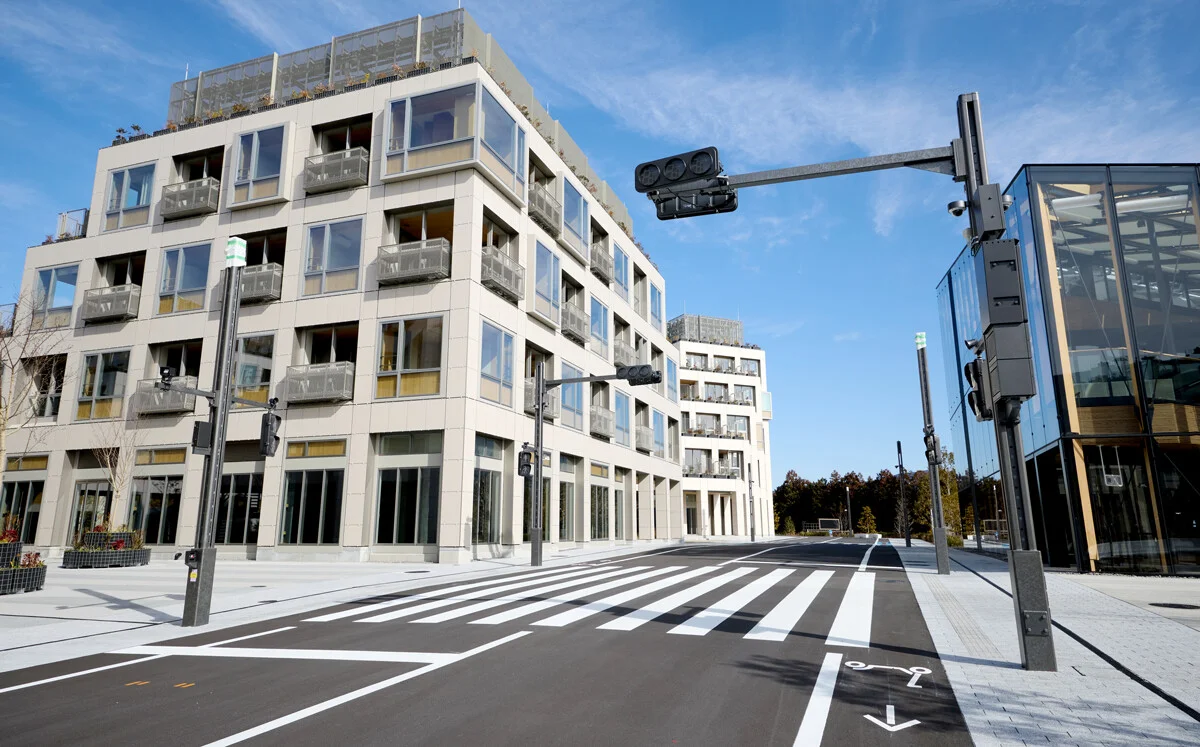
Toyota Motors North America approached the Center for Digital Experiences for research as part of their Woven City project, a prototype community that seeks to redefine the future of mobility and technology in urban environments. A major aspect of this initiative is addressing pedestrian safety, as physiological factors such as blindness and low vision are underserved in civic design. This also includes feelings of safety, which is necessary for developing urban communities where walking as a mode of transportation is encouraged.
The core research question we set out to answer was:
"How might we increase feelings of safety and independence for pedestrians with blindness or low vision?"
My contribution
UX Researcher
The team
Solo project
Timeline
January - May 2025
Ethnographic Research Methods
To fully understand the experience of blind and low-vision pedestrians, especially when it relates to navigating city environments, I opted to use a mixed methods approach combining observational fieldwork, qualitative interviews, longitudinal diary studies, and secondary research.
Observation
Contextual
Field observation at two NYC intersections (one in Manhattan, one in Brooklyn), documenting pedestrian behaviors, crosswalk infrastructure, and sensory context in real conditions.
Interviews
Qualitative
In-depth qualitative interviews with 4 low vision individuals recruited through blind and low vision community support groups and optometrists familiar with how patients articulate their pain points.
Diary Study
Longitudinal
Two blind participants submitted longitudinal diary study entries documenting their pedestrian experiences related to vision, capturing moments of challenge and relief over time.
Secondary Research
Desk Research
Analysis of news articles, NYC disability and transportation statistics to ground primary research in established data and understand how blindness and low-vision is documented in media.
03: Key Insights & Opportunities
The pedestrian experience starts before leaving the home
Blind and low vision pedestrians cannot rely on visual stimuli outside the home. Before stepping outside they must pre-plan every step, map out their daily route, and account for unfamiliar terrain, resulting in heavy cognitive load.
"When I visit a new place, it's all a little anxiety producing when I have to learn an entire area." - Interview participant
“As a blind person I have to be able to create a mental map of where I'm going." - Interview participant
Opportunity
Design solutions that give pedestrians the freedom to react rather than plan, reduce dependency on exhaustive pre-trip preparation.
Sound is essential for location and orientation
60% of diary study entries explicitly referenced auditory information as a critical factor in pedestrian safety decision-making. Especially in cities, there is an abundance of environmental noise (traffic, construction) making it essential that designed audio signals can be used to orient pedestrians that rely on sound as a main method of information gathering..
"When I was in places where they didn't have that crosswalk sound, I didn't know what location I was going, whether it was North to South or East to West." - Interview participant
"It's not safe unless you have directional sound." - Interview participant
Opportunity
Any information communicated via sound must make decision-making intuitive. Directional audio (not just presence of sound) is what creates meaningful spatial understanding at crosswalks.
Crosswalks are a primary source of anxiety
The crosswalk moment concentrates the maximum amount of uncertainty: traffic is unpredictable and the consequences of error are severe. Only 5% of NYC's signalized intersections have APS devices, leaving pedestrians to improvise at the most dangerous moment of their journey.
"Having the ability to restart, go back to the sidewalk, and start again is really important because you gain that sense of control." - Interview participant
"When I hear an A.P.S., I feel safe." - Blind New Yorker, New York Times
Opportunity
Supplement the crosswalk experience with richer sensory information. Eliminate uncertainty at the point of highest risk to restore the pedestrian's sense of control over their environment.
Segregated solutions fail; integrated ones endure
Assistive tools built specifically for low vision users are stigmatizing and ultimately underperform in real life scenarios. Existing assistive tools like the Aira visual interpreting app ($400–500/month) or handheld reverse telescopes are either financially out of reach or too cumbersome for everyday use, and almost none are integrated into the infrastructure pedestrians already encounter.
"Don't build something specifically for blind people, because if it's separate, it'll never be good." - Interview participant
“It's amazing the things they assume about us and never actually get right." - Interview participant
Opportunity
Integrate accessibility features into mainstream city infrastructure rather than building parallel systems. A solution embedded in the crosswalk signal itself, not a separate device, reaches the most people.
The Proposal
Introducing CrossBeacon:
Crosswalk signals are overwhelmingly visual. Accessible Pedestrian Signals (APS), devices that emit auditory cues, exist at only 5% of signalized intersections across the city. That gap forces pedestrians who can't rely on sight to default to improvised crossing strategies or avoid them entirely.
As a demonstration of how the Woven city could implement integrated solutions that serve this underserved demographic, we proposed the CrossBeacon: a bi-directional speaker system embedded directly into existing crosswalk signal infrastructure. It communicates sidewalk waiting areas, the crosswalk path across the street, and remaining crossing time without requiring any personal device or separate tool, creating equity in the pedestrian experience for blind and low-vision individuals.
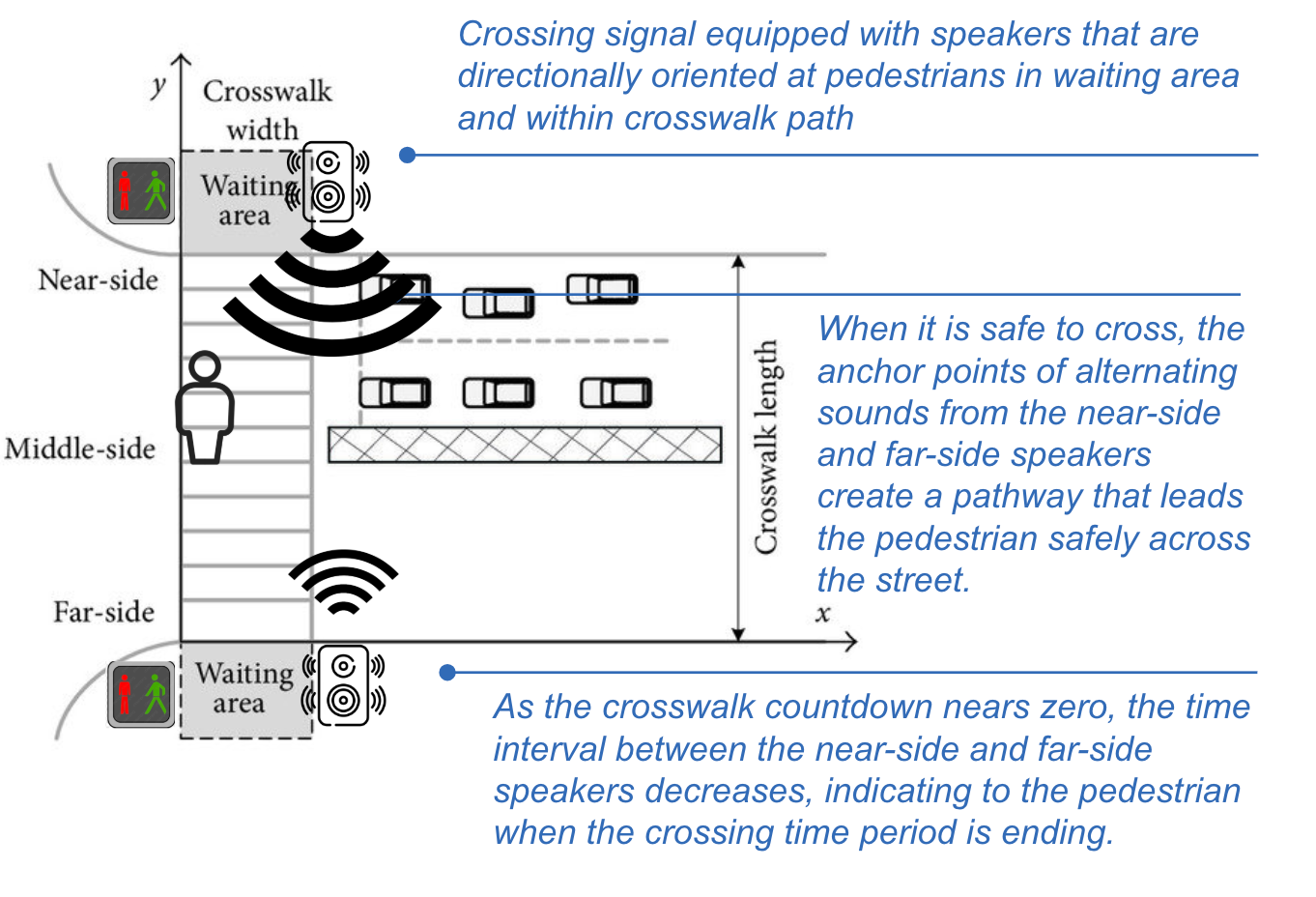
- Speakers are attached to crosswalk signals pointed towards each adjacent sidewalk waiting area.
- When the crosswalk sign indicates that it is safe to cross, the speakers will alternate beeping sounds, creating an auditory pathway that guides pedestrians across the street. This bi-directional alternating signal turns sound into valuable navigation information.
- As crossing time nears zero, the interval between speaker alternations shortens, conveying the remaining time until the crossing period ends and traffic resumes.
Impact and Next Steps
Toyota’s Woven City officially launched in September 2025 with a population of 300 initial residents. As part of their initiative to enable pedestrian safety, they included city-wide traffic signals and multifunctional poles that coordinate traffic signals with mobility using cameras and sensors. There is still ample opportunity to design the soundscape of the Woven City using auditory signals as a method of communicating environmental information as the Crossbeacon. Woven City’s current trajectory is largely optimistic due to Toyota welcoming both ideas from enterprise and visitors to the area, leveraging ethnographic observations and ideas from a real life prototype community.