Increasing Digital Exposure: Expanding Canon’s Brand and Conversion
Canon

Overview
Canon USA is a leading provider of digital imaging solutions, including cameras, with a history dating back to 1934. They are the leader in the United States, Canada, Latin America, and Caribbean markets.
Our group chose Canon as the client because we were interested in the idea of reviving a brand that had its heyday before the modern internet. Canon is viewed as a legacy brand that is most well known for serious film photography, and in recent years there has been a resurgence of this field led by an interest in analog and digital cameras. How should Canon approach this opportunity to reach both existing audiences who want to relive their experiences and new audiences that are more interested in learning what all the fuss is about?
Despite high domain authority, Canon faced "untapped performance opportunities" and a need to translate raw search and social data into actionable visibility and conversion improvements. Our research team wanted to use web analytics to identify where Canon was succeeding and failing in converting users visiting their website and social media profiles.
My contribution
UX Researcher
The team
5 UX Researchers
Timeline
March - May 2026
Framing the problem / Goals
Despite its status as an industry leader, Canon’s digital presence faces several critical issues:
- Missing content in on-page SEO (e.g. 1044 links with no anchor text) limits the site’s ability to attract exploratory audiences.
- High bounce rate from high traffic pages.
- Social media accounts for only 1.63% of desktop traffic, with a heavy reliance on branded traffic rather than non-branded discovery.
The overall goal of this project was to increase web traffic and improve online visibility. Our team broke down this objective into four separate aspects of Canon’s brand:
- Enhance existing website SEO performance
- Expand audience into beginners and content creators
- Strengthen non-branded content search visibility
- Improve overall social media engagement and reach
Methodology
I collaborated with four other UX Researchers over a period of three weeks to audit Canon’s online brand and offerings. In order to get a comprehensive overview, we divided the work up into technical SEO, on/off page SEO, keyword research, content funnel, and social media. Some of the tools we used included SEMrush and Similarweb to look at keywords, crawl health, backlink profiles, and social engagement hierarchies. Our three audit step process was:
- Evaluate current performance across search, web, and social channels
- Translate insights into clear, actionable recommendations for Canon
- Improve online visibility, attract the right users, and drive measurable results
Key Findings
Technical SEO - Strong visibility, untapped performance opportunity
Overall, Canon demonstrates a strong overall SEO performance, supported by high domain authority, stable organic and paid traffic, and a well-established backlink profile. They had an overall site health of 86%, site performance of 95%, and crawlability score of 96%.

However, there are structural gaps that limit Canon’s ability to fully leverage existing authority and traffic potential. These include poor web vitals, with their top 10 key webpages (including homepage, category, and product pages) being slow and unstable, making it hard to keep new visitors engaged. They also have structural gaps including incorrect heading hierarchy, missing H1s, and missing alt text, limiting their ability to fully leverage existing authority and traffic potential.
These technical gaps directly impact non-branded discoverability and entry points for new users, limiting Canon’s ability to attract beginner and exploratory audiences.
On/Off Page SEO - Strong authority and weak signal quality
Canon demonstrates a strong on/off-page SEO foundation, supported by stable organic traffic, a large-scale backlink profile and solid domain authority. However, deeper analysis reveals that this authority is not being fully leveraged due to inefficient signal quality and fragmented content connections.

However, they have 3.9K total toxic backlinks, with an additional 10K that are potentially toxic, meaning that 27.2% of their backlinks are from spammy or link-network domains. They have a weak anchor text strategy, with an over-reliance on branded anchors that do not provide keyword context.
Content Funnel - Failure to guide users toward product exploration and purchase
The content funnel analysis uncovered a critical disconnect in the user journey from discovery to conversion. Learning content lacks direct links to relevant products, navigation pathways do not support decision-making, and call-to-action elements are often misaligned with user intent.
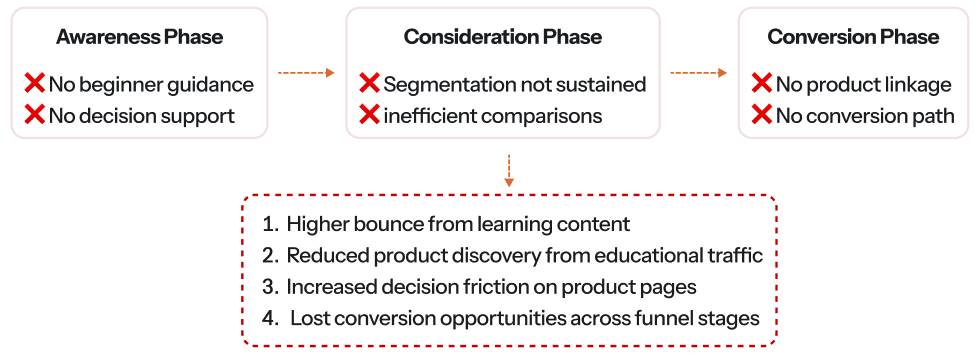
When users arrive at the Canon website, they lose guidance as they move through the funnel, leading to friction, confusion, and drop-off before conversion. To strengthen non‑branded visibility, parts of the site should be reframed around jobs to be done for creators and beginners and technical elements such as headings should reinforce those themes.
Social Media Analysis - Reliance on legacy status and lack of content strategy
Canon’s social media accounts for 1.63% of total desktop traffic, leaving a large opportunity for growth in the space, particularly with YouTube and Instagram.

Overall, Canon’s social media content is heavily awareness-focused, with limited lower-funnel strategies (e.g., product education or purchase drivers), and is too technical, acting as a barrier to more casual audiences who are more interested in entry-level product use cases. Both of these issues result in lower conversion of new and beginning users by lowering CTR and engagement rates.
Recommendations
High-priority: Enhance existing website SEO performance by fixing metadata and targeting keywords with low difficulty
Canon has a high volume of missing information, and they can easily increase their SEO by simply fixing empty anchor links and incorrect sitemap entries. Examples of keywords that they can target include “best digital camera for beginners”, “beginner level dslr”, “vlogging camera”.
High-priority: Widen audience to beginners and content creators through creating and promoting top of the funnel content on their site and social media
Canon should reframe their social media strategy to capture non-branded keywords and beginner audiences at top of the funnel.
Medium priority: Strengthen non-branded content search visibility by focusing on intent-based anchor text
By focusing on intent-based anchors to improve non-branded visibility, Canon can remain competitive by entering the area of users that are not specifically already searching for Canon products.
Long term strategy: Improve overall engagement and reach by tracking and evaluating performance metrics of website and social media campaigns
Without a dedicated resource for checking on Canon's site and social media and performing, they cannot properly evaluate how the changes they decide to implement are being received by their audiences. We recommend creating a dashboard for both their website and social media to solve this issue.


By implementing the aforementioned dashboards, Canon will be able to better evaluate the performance of top pages and social media channels to determine what aspects of their SEO and social media are helping or hindering their efforts.
Conclusion / Reflection
Pitching to stakeholders
Our team presented to Canon stakeholders in person to deliver both our findings and recommendations. The main theme in our presentation was the need to both strengthen non-branded search visibility and change their content strategy to capture the audience of beginners and content creators. By implementing the aforementioned dashboards, Canon will be able to better evaluate the performance of top pages and social media channels to determine what aspects of their SEO and social media are helping or hindering their efforts.
My contribution
I focused on analyzing their social media and investigating how Canon used its social media accounts to raise awareness and drive traffic to their site compared to companies in the same industry space. I also conducted a competitor analysis of companies operating in the same camera product space: Fujifilm, Nikon, Polaroid, and Sony. By understanding how these other companies used their social media accounts to capture new audiences and drive them to their website, we were able to figure out ways for Canon to do the same while remaining true to their brand.
Reflection
This project was a successful exercise in being able to conduct a full scale website audit and pulling actionable insights from the vast amount of data. The toughest part was not finding insights, but instead creating a cohesive story for the presentation with five different researchers that have different opinions and styles. In the end, the most effective method was to divide and conquer in the audit, and then come back together to meet and discuss how the conclusions we reached related back to the goals of the project. I improved in my ability to analyze different platforms and use social media metrics to find patterns in how effective different brands were in raising awareness and funnelling users to their website.